
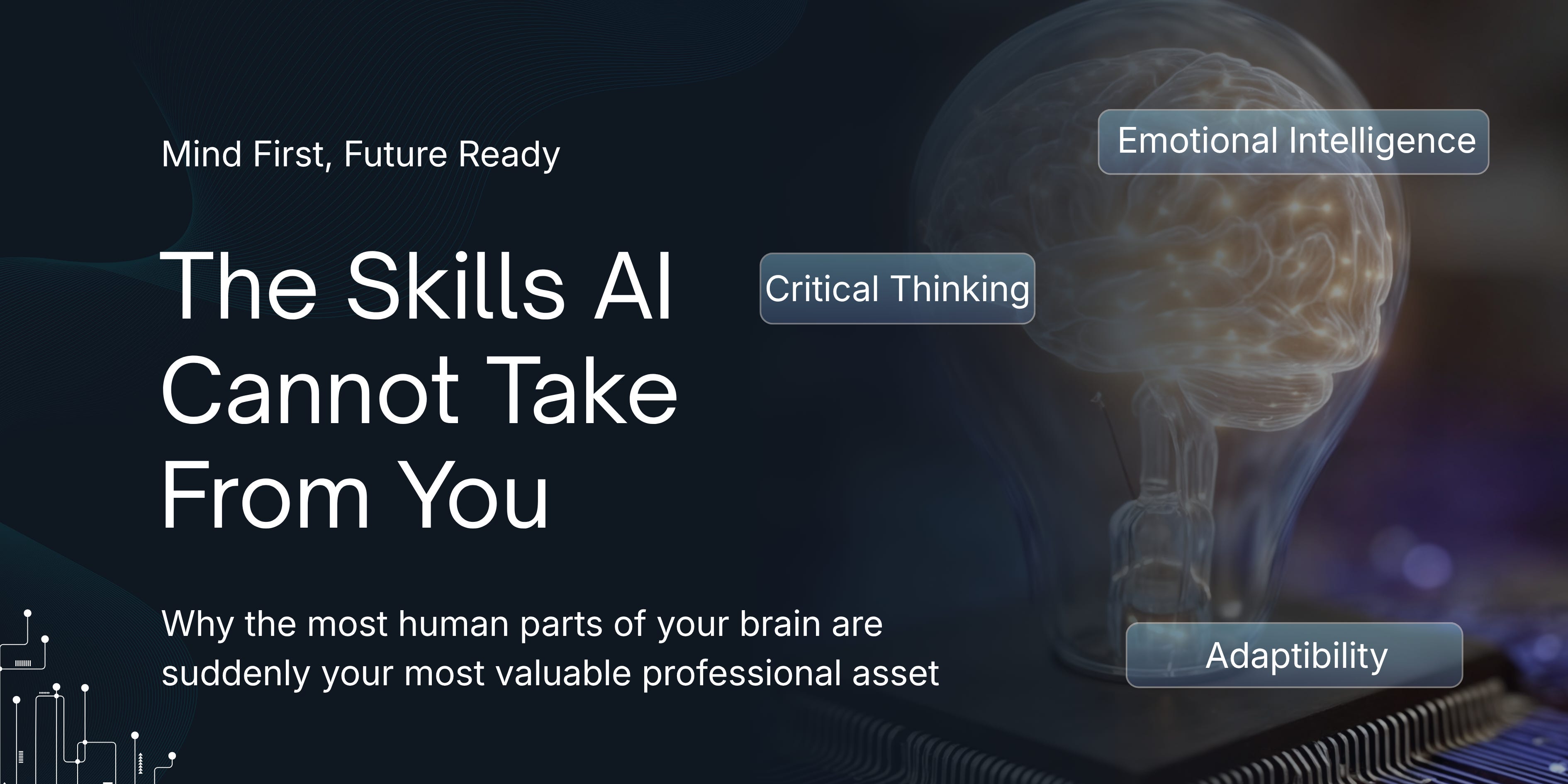
The Skills AI Cannot Take From You
Why the most human parts of your brain are suddenly your most valuable professional asset

You probably already use AI to write faster, research deeper, or draft what used to take you an hour.
That’s good. But here’s the question nobody is asking out loud: what happens when everyone around you does the same thing?
If everyone has the same AI tools, the only differentiator left is what sits between your ears and behind your eyes. The judgment. The empathy. The originality. The courage to lead when the situation is ambiguous and the data runs out.
That is what this issue is about.
The Great Sorting Is Already Happening
Between 2025 and 2030, foundational shifts in the global economy are expected to impact nearly a quarter of all jobs. 22% of today’s roles will either fully disappear or be revised completely.
That’s not a prediction from a science fiction writer. That’s the World Economic Forum’s Future of Jobs Report, drawing on over 1,000 global employers representing 14 million workers.
And here’s the piece most coverage misses: Microsoft research shows 80% of workers will only see tasks automated, not full roles.
Tasks go. Roles evolve. Humans who understand that distinction will move forward. Those who don’t will stand still wondering what happened.
Think of it like a river. AI is clearing the shallow water, the sediment, the repetitive silt. What remains on the riverbed after the current passes is the gold. That gold is you, but only the parts of you that AI genuinely cannot replicate.
What are those parts?
Five Skills That Sit Outside the Algorithm’s Reach
1 - Creativity
Not creativity in the abstract. Not daydreaming or mood boards.
Creativity as the ability to connect two unrelated ideas and produce something genuinely new because you lived through something that no dataset has ever catalogued.
AI generates by recombination. It reshuffles what already exists at extraordinary scale and speed. What it cannot do is have a lived experience, feel the specific frustration of your customer, or draw meaning from a moment in your own life and translate it into something that moves another person.
The people who will matter in the next decade are not those who use AI to create. They are those who use AI as a tool while anchoring the creative direction in distinctly human insight.
2 - Critical Thinking and Problem-Solving
Here is a useful frame: AI is very good at answering questions. It is not good at knowing which question to ask.
That distinction is enormous.
The World Economic Forum and McKinsey both place critical thinking at the top of required skills for 2025 through 2030. Not because critical thinking is trendy, but because every AI output requires a human capable of interrogating it, testing it against reality, and deciding what to do when the model is confidently wrong.
Problem-solving is the bridge between thinking and doing. It requires tolerance for uncertainty, willingness to be wrong, and the ability to act before the picture is fully clear. That is not a prompt. That cannot be automated.
3 - Emotional Intelligence
A model can recognize that someone wrote “I’m fine” in a flat tone. It cannot feel the weight behind it. It cannot sit with discomfort, hold space, or earn trust through consistent presence over time.
Jobs requiring human connection and physical presence show the lowest AI applicability scores, according to the largest real-world study on AI’s impact on work, based on nine months of conversations from 200,000 Microsoft Copilot users.
Emotional intelligence is not soft. In an environment where interactions are increasingly mediated by machines, the person who can read a room, navigate tension, and make someone feel genuinely heard becomes extraordinarily rare and therefore extraordinarily valuable.
4 - Leadership
Leadership is not task management. AI can now handle briefings, data summaries, OKR tracking, and meeting notes. What it cannot do is build a culture, hold a team together when direction is unclear, or make a values-based decision when the right choice is also the costly one.
Roughly 80% of core leadership work remains human, including vision setting, culture building, conflict resolution, stakeholder management, ethical decision-making, and leading change. Only about 20% is well-suited for AI support.
The leader who learns to delegate the 20% to AI and sharpen the 80% will outperform peers significantly. Not by working harder, but by directing their human capacity exactly where it matters.
5 - Adaptability and Continuous Learning
This one is less glamorous but perhaps the most urgent.
People are now more than twice as likely to acquire AI skills than in 2018, and paradoxically, the greater focus on technology means human skills are also in higher demand.
Job postings requiring AI skills are growing over 70% year-over-year, and roles requiring AI skills are nearly twice as likely to also request analytical thinking, resilience, ethics, and digital literacy.
AI fluency and human capability are not in competition. The data shows they travel together. The person who treats learning as a continuous practice rather than a one-time credential will stay relevant across multiple technological cycles, not just this one.
The Honest Tension Worth Naming
There is a version of this conversation that gets too comfortable too quickly. It says: do not worry, AI just handles the boring parts, and humans do the interesting stuff.
That framing is partially true and partially wishful.
The real picture is sharper. Experimental evidence shows that while AI can enable non-technical workers to perform technical tasks, these gains may be temporary. Workers lose the capability to perform those tasks once access ends, indicating no lasting skill development.
This means relying entirely on AI to do your thinking is not a shortcut. It is a slow erosion.
The question is not whether to use AI. You should, and you will. The question is whether you are using it in a way that sharpens your judgment or replaces it.
Use AI to scale what you already understand well. Do not use it to skip the process of developing understanding in the first place.
Key Takeaways
Creativity rooted in lived experience is irreplaceable because it cannot be reverse-engineered from existing data.
Critical thinking is the skill that makes every AI output actually useful. Without it, the output is just confident noise.
Emotional intelligence is growing more valuable, not less, as human contact becomes rarer in professional environments.
Leadership at its core is a human activity. AI handles the logistics. You handle the meaning.
Adaptability is not a personality trait. It is a practice. Build the habit of continuous learning before you need it.
A Reflection for This Week
Pick one skill from this list that you rely on least right now.
Not the one you are best at. The one you have quietly been delegating to habit, routine, or in some cases, a chatbot.
Ask yourself: what would it look like to invest one focused hour per week into that specific skill for the next month?
That is not a big commitment. But it compounds.
One Step Forward
If this landed, share it with one person on your team or in your network who is navigating this question right now.
Not because it will solve the problem, but because the conversation itself is the first move. Understanding which parts of you are irreplaceable is not a philosophical exercise. It is a practical advantage.
The tools will keep improving. So should you.
Sources referenced in this issue:
World Economic Forum Future of Jobs Report 2025: https://digital-skills-jobs.europa.eu/en/latest/news/great-skills-reset-wefs-future-jobs-report-2025-catch-22-future-work
Microsoft New Future of Work Report 2025: https://www.microsoft.com/en-us/research/wp-content/uploads/2025/12/New-Future-Of-Work-Report-2025.pdf
Microsoft Copilot real-world AI applicability study: https://www.finalroundai.com/blog/jobs-ai-cant-replace-in-2025
WEF on AI and human skills at work, January 2025: https://www.weforum.org/stories/2025/01/ai-workplace-skills/
McKinsey and WEF skills projections: https://prometai.app/blog/10-jobs-ai-wont-replace-future-proof-careers-for-the-ai-era